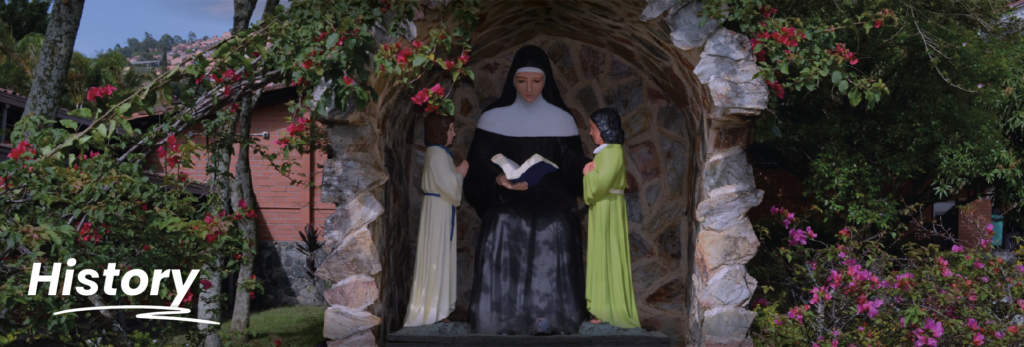
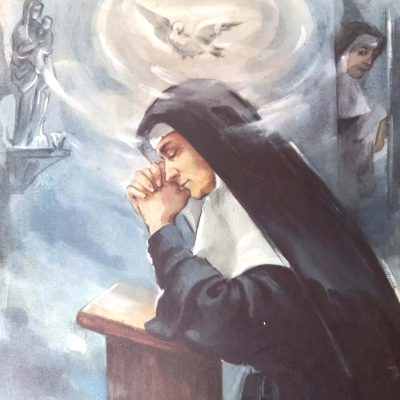
In prayer and in the desire to serve God, Jeanne understood: young women were getting lost for lack of help: it was necessary to reach out to them and in silence she found the answer: to found
“A Religious Order, hitherto unknown in the Church” with the following goals:
- To offer young women desirous of serving the Lord a community with a contemplative-apostolic lifestyle that would not exceed physical strength.
- To open schools that, under the protection of Mary, Our Lady, would spread her name and her influence among the young women, through a Christian humanist education.
Fathers John de Bordes S.J., and Francis Raymond S.J. also wanted to found a Female Religious Order, so that girls would enjoy the same education that they offered to boys throughout France. They then went to visit Jeanne and with their help, Jeanne was sure that the enlightenment she had was not the effect of imagination, but of God’s will. She, who already had the inspiration, dedicated the rest of her life to respond to this call.
Jeanne thought that the joint effort of a community could achieve whatever it set out to do. She began to look for companions and to design the work, which had very different characteristics from those of the other communities that already existed. She intended: To educate young women in Christian humanism; to cultivate devotion and imitation of Our Lady; and to offer women an apostolic religious lifestyle, possible for all who would be thus called.
On March 25, 1606, the Archbishop of Bordeaux announced the approval that they would later request from Rome, which was given by means of the Brief that certifies the approval as an ORDER OF OUR LADY, by Pope Paul V, on April 7, 1607.
On May 1, 1608, the sisters of the Order were consecrated to God for the service of the education of young women in the Christian faith. In 1610 they made their profession of Solemn Vows. Twelve foundations came out of this first house in Bordeaux, nine on the initiative of Jeanne and three after her death. Thirty ministries were begun in different parts of France during the lifetime of the Foundress.
Ten years after her death in 1650, the community of Béziers founded the first house in Spain, Barcelona. From there, Tudela was established in 1687, which became a bridge for the leap to America with the foundations of Mexico in 1774; Mendoza (Argentina) in 1780 and Santa Fe de Bogotá in 1783.

Evolution of the division into Provinces
When the Company was born in 1607, it had a structure of Government that corresponded to the historical moment: Religious of Solemn Vows and with a fourth vow of closure in autonomous Houses each led by a Superior and her Council. They were united by epistolary communication with the frequency that the incipient means of communication allowed.
In 1956 a Centralized Government was established: a Superior General with her Council. This was proposed in the Brief “Provindentis Dei” of December 27 when Pope Pius XII instituted a centralized hierarchical regime, in which “The Order is divided into Provinces under the authority of a Superior General that extends to the entire Order: Provinces, Houses, members and goods of the Order.”
At that time, the Province of Colombia began, with headquarters in Bogotá. Medellín in 1899, Pereira in 1926 and Barranquilla in 1941 already existed.
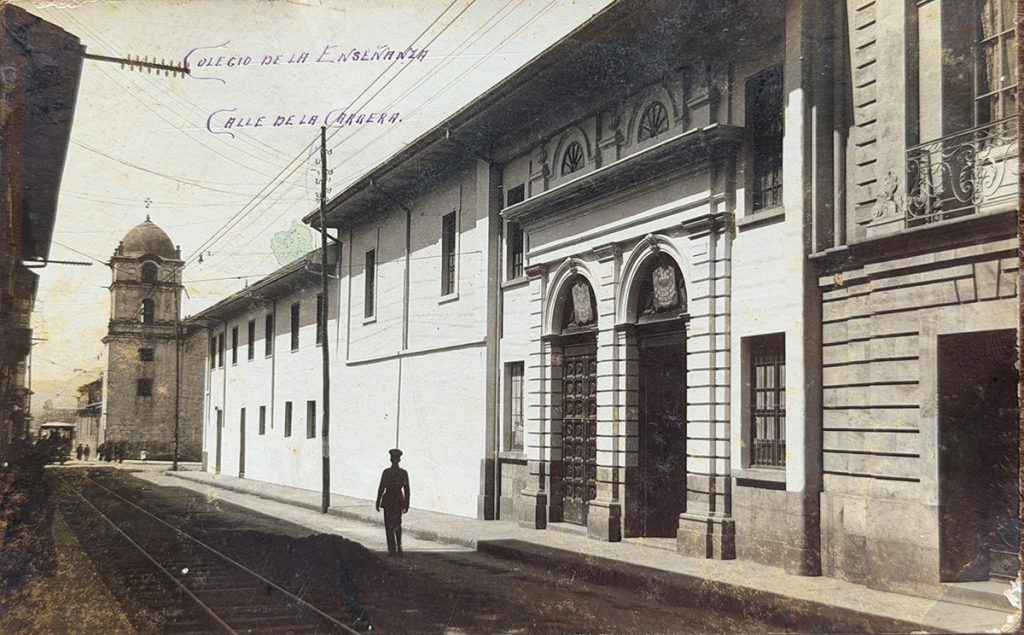
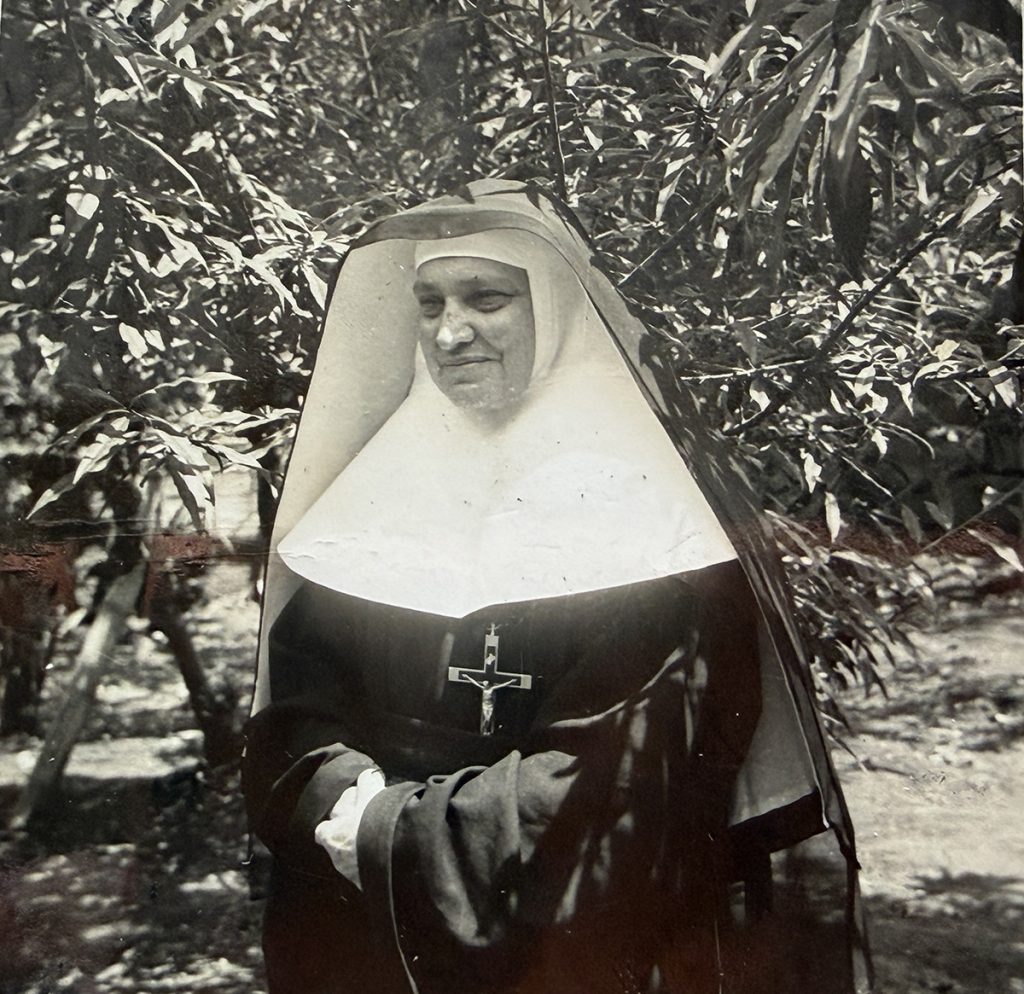
Around 1963, Mother Provincial Ana Afanador Salgar asked the General Chapter to divide Colombia into two Provinces, for better attention to the Communities and Apostolic Works. The Province of Bogotá remained and the Province of Medellín began.
In 1972 the Order began in Pasto and thus the Order grew in Colombia.
In 1979 the Provinces of Risaralda and Nariño were established with the authorization of the XI General Chapter of the Company. Nariño was suppressed in March of 1988, and the existing Houses were taken over by the Provinces of Bogotá, Medellín and Risaralda.
In March 1997, the delegation of Peru was added to Medellín and it was called the Province of Medellín-Peru.
In 2003, Mother General Beatriz Acosta Mesa saw the need to return to a single Province in order to give unity, organizational structure and identity to the project of the Company.
After serious thought , reflection, prayer and discernment, a decree dated in Rome on September 23, 2003, was issued, by which the existing Provinces of Bogotá, Medellín and Risaralda were abolished and a single Province was established, to be called the Province of Colombia-Peru, with headquarters in Bogotá.